Investing in real estate is one of the most popular wealth-building strategies in Kenya. Traditionally, Kenyans have favored buying physical property as a way to grow wealth. Land, rental apartments, and commercial buildings have been some of the preferred investments. However, Real Estate Investment Trusts (REITs) are emerging as an alternative way to invest in the property market without the hassle of direct ownership. But which is the better option?
Understanding REITs and Physical Property Investment
Real Estate Investment Trusts (REITs) are companies that own, operate, or finance income-generating real estate. Investors buy shares in a REIT, similar to how they buy stocks in a company. The main REITs in Kenya, such as ILAM Fahari I-REIT, allow investors to earn rental income and capital appreciation without direct property management.
Physical Property Investing involves purchasing land, residential, or commercial buildings with the aim of earning rental income or benefiting from property value appreciation over time. This is the traditional approach to real estate investment in Kenya.
Comparing the Two Investment Options
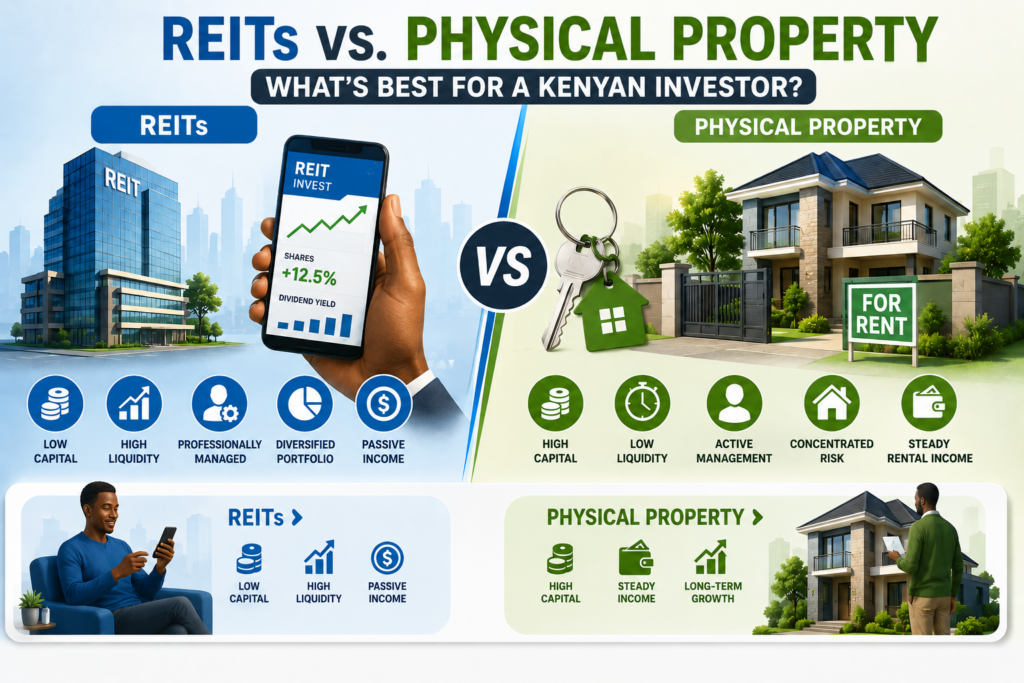
| REITs | Physical Property | |
| Capital Required | Low – Investors can start with as little as Ksh 5,000 | High – Requires substantial capital to buy land or buildings |
| Liquidity | High – Investors can buy or sell shares easily | Low – Selling a property can take months or years |
| Management | No direct involvement – Professionals manage the properties | Requires active involvement – Finding tenants, maintenance, taxes, etc. |
| Diversification | High – A REIT invests in multiple properties, reducing risk | Low – An investor may own only a few properties, concentrating risk |
| Income Consistency | Moderate – Dividends depend on REIT performance and economic conditions | High – Rental income is usually consistent unless vacancies occur |
| Regulatory Risk | Subject to stock market fluctuations and regulations | Subject to property laws, taxation, and land disputes |
Which One Is Right for You?
- Choose REITs if: You prefer a passive investment with lower capital and higher liquidity. This is ideal for investors who want exposure to real estate without the responsibilities of property management.
- Choose Physical Property if: You have substantial capital, prefer direct control over your assets, and are looking for stable rental income or long-term appreciation.
Final Thoughts
For Kenyan investors, both REITs and physical property have their pros and cons. While traditional property ownership remains popular, REITs provide a compelling alternative, especially for those looking to invest with limited capital. The best approach may be to combine both. Own physical property for long-term growth and invest in REITs for liquidity and passive income.
About the Author